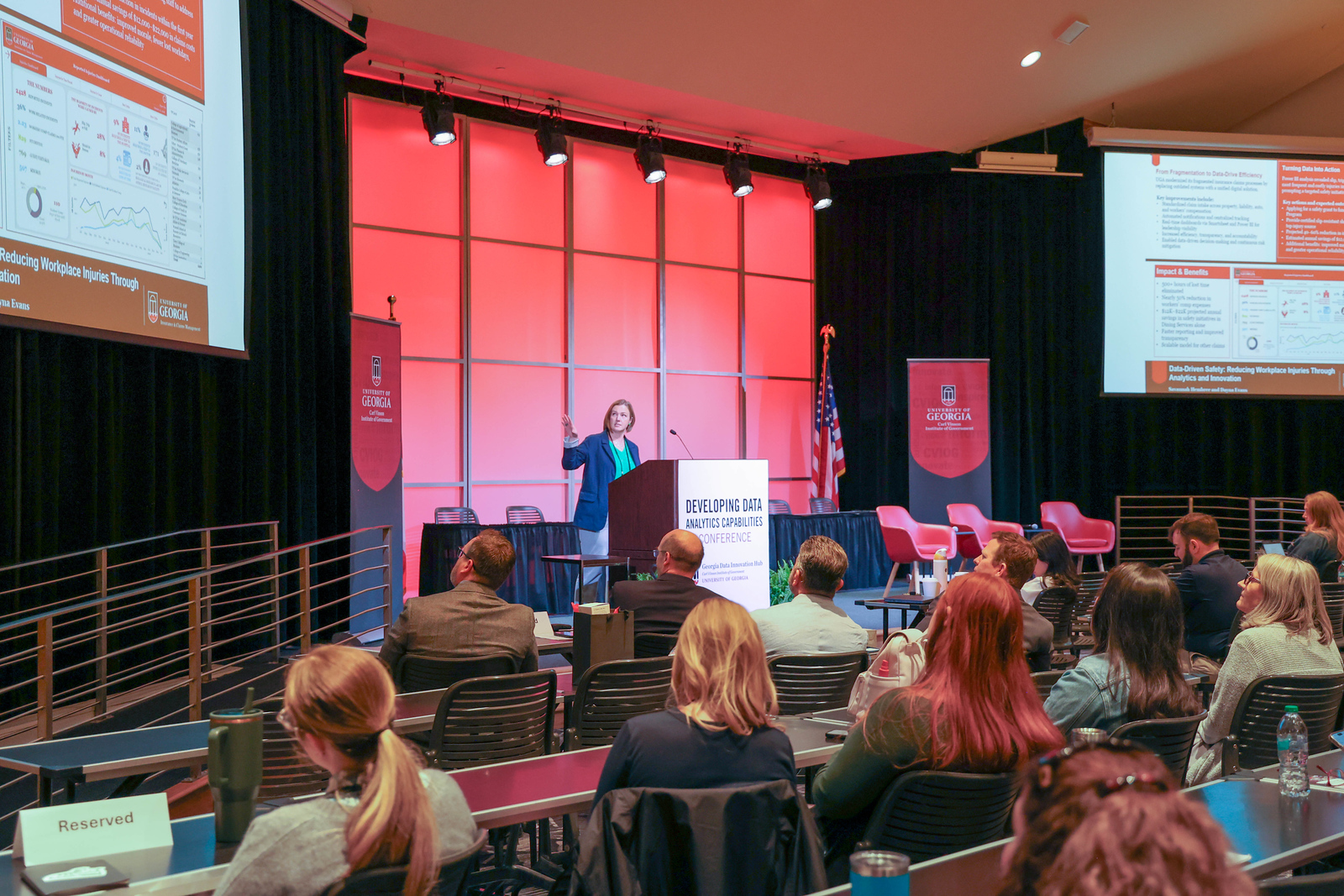
Workplace injuries would not appear to be a data-rich subject, but a project that modernized workplace injury reporting and analysis took top honors in the recent Data Analytics Olympics. The Olympics, a new competition hosted by the UGA Carl Vinson Institute of Government’s Georgia Data Innovation Hub, showcases outstanding examples of data analytics, dashboards, and decision-support tools.
The gold medal-winning project, “Turning Data into Action,” was submitted by Savannah Hembree, business manager in the UGA Office of Emergency Preparedness and Insurance and Claims Management (ICM). Dayna Evans, ICM workers’ compensation coordinator, was co-author.
“My goal in entering the competition was to demonstrate that meaningful data work isn’t limited to data scientists or analysts by title,” Hembree said. “I wanted to encourage others, especially operational professionals, to explore creating dashboards and reports that go beyond routine reporting and tell a clearer story.”
The project reflected work by ICM, Human Resources and other campus stakeholders to modernize UGA’s injury reporting with a more unified digital system. The new reporting system uses Power BI reports to analyze the data.
The result is real-time access to injury report data, allowing leaders to make decisions that decrease injuries, lower workers’ compensation claims, and identify opportunities for improvement and training. In the first year, UGA reduced lost work time due to employee injuries by about 500 hours and cut workers’ compensation costs by almost 50%.
The project was one of several entries in the competition. Participants tackled real-world data challenges with innovative data dashboards and other tools featuring effective data analysis, creative visualizations and clear insights. The competition was launched at the Developing Data Analytics Capabilities Conference, which gathers data professionals each spring to enhance their skills and learn about the latest developments in data analysis.
“The Data Analytics Olympics is another way for us to showcase people in this community of practice who are using data to inform decision-making. Each of our winners demonstrated how data analytics can contribute to operational efficiencies and a strong return on investment,” said David Tanner, Institute of Government associate director.
 |
|
Gold, Silver and Bronze Data Olympics winners were recognized at the Developing Data Analytics and Capabilities Conference. From left to right, Eric McRae, associate director, Institute of Government; Kate Heidenreich, research analyst, Judicial Council of Georgia Administrative Office of the Courts’ Office of Research and Analysis; Savannah Hembree, business manager, UGA Office of Emergency Preparedness and Insurance and Claims Management; Will Wright, principal data scientist, Atlanta Regional Commission Research and Innovation; and David Tanner, associate director, Institute of Government. Photo by Cameron Pearce |
Competitors submitted posters about their data innovations, and conference participants selected their favorites. The top three then gave presentations following a conference plenary session, and attendees voted on the winners.
Will Wright, Atlanta Regional Commission Research and Innovation principal data scientist, earned the silver medal with his presentation of the Georgia Department of Transportation’s GDOT Project Map.
The public-facing tool, developed and maintained by Wright and his team, consolidates GDOT’s projects into one interactive, filterable interface. Previously, local governments, elected officials and the public struggled to understand what GDOT was building, where and at what cost. Stakeholders can now use the tool to explore GDOT infrastructure investments in their community.
Kate Heidenreich, research analyst at the Judicial Council of Georgia Administrative Office of the Courts’ Office of Research and Analysis, received the bronze medal for her project on state court caseload data.
Heidenreich presented interactive dashboards that show the data in a clear, accessible format. The tool increases the state judicial system’s transparency, accountability and trust by making court data easier to search, understand and compare.
Hembree, Wright and Heidenreich were recognized at the conference’s closing luncheon.
“We all work with data every day, regardless of our job duties, and every data point tells a story,” Hembree said. “When people feel empowered to experiment with data and visualize it in more meaningful ways, it elevates both individual confidence and organizational decision-making.”